Massachusetts Roofing Permits: The Complete 2026 Guide for Contractors
A working guide to filing residential roofing permits in Massachusetts — written for contractors and office managers who are tired of every town doing it differently. What's actually required, what you can skip, and how to get a packet approved on the first try.
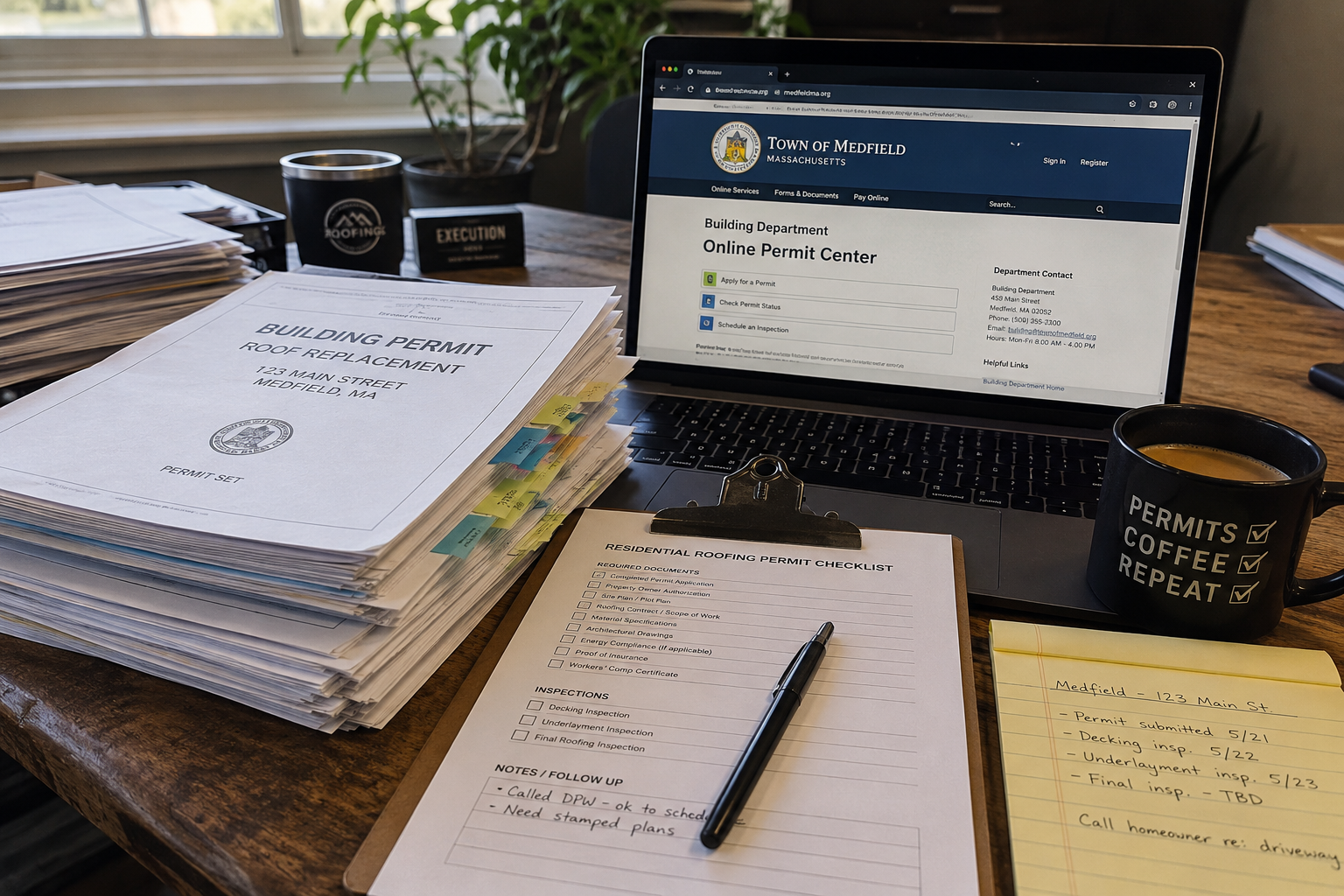
If you've filed more than a handful of roofing permits in Massachusetts, you already know the punchline: there isn't one way to do it. There are 351 ways, one per town. The state sets the rules, the towns enforce them, and somewhere in between is the inspector who has their own preferences.
This guide is the high-level map — what every MA roofing contractor needs to know to file a residential roofing permit anywhere in the state. It covers the licensing requirements, what's in a typical permit packet, where towns diverge, what gets rejected most, and where the 2026 energy code changes affect roof work.
It's the pillar piece. For town-specific details — actual fees, actual inspectors, actual turnaround times — see our town pages as we publish them.
Who Can Pull a Residential Roofing Permit in Massachusetts
This is the single most common source of rejected applications in Massachusetts. Get this part right and you'll already be ahead of most contractors.
Two separate licenses matter for residential roofing work:
HIC — Home Improvement Contractor Registration
Required for anyone doing residential remodeling work, including roofing, on owner-occupied 1-4 family homes. This is a registration, not a license — administered by the MA Office of Consumer Affairs and Business Regulation. Most legitimate residential roofers carry one.
CSL — Construction Supervisor License
Required to pull a building permit for structural work on 1-4 family residences under the MA State Building Code. There are multiple classes — CSL Unrestricted, CSL Restricted (1-2 family), CSL Specialty (Roof Coverings), etc. For most residential reroof work, a Restricted or Specialty CSL is sufficient.
The mistake most often rejected: An HIC-only contractor trying to pull a permit without a CSL listed. The town clerk often doesn't catch it at intake, but the application bounces at building-department review. Always have the CSL holder's name and number on the application from the start.
If your company does residential work, you typically need both. The HIC covers your business relationship with the homeowner. The CSL is what allows you (or someone on staff) to actually pull the permit.
What's in a Standard Massachusetts Roofing Permit Packet
The Massachusetts Uniform Building Permit Application is the statewide form most towns accept as the base document. Beyond that, almost every town adds requirements. Here's what shows up consistently:
- The completed permit application — signed by both the contractor and the property owner (the owner-of-record signature is a frequent oversight)
- Copy of contractor's HIC registration card
- Copy of CSL license for the named supervisor
- Certificate of Insurance (COI) showing current general liability coverage, typically naming the town as additional insured for some municipalities
- Workers' Compensation Insurance Affidavit — a Massachusetts-specific form (DIA-issued) required by most towns even if you have no employees
- Detailed scope of work — square footage, materials, layer count (strip vs. overlay), and any structural changes
- Estimated project value — used by the town to calculate the permit fee
- Site address and parcel ID (some towns require both)
Items that some towns require but most don't:
- Architectural drawings (rare for in-kind reroofs, sometimes required for changes in pitch, dormer additions, or structural work)
- Energy code compliance documentation (more common in Stretch Code and Specialized Code towns — see below)
- Historic district review (only in designated historic districts — Newton, Concord, Salem, etc.)
- Separate dumpster or staging permits
- Snow load engineering (for changes in deck or framing in certain zones)
What the Massachusetts Building Code Actually Says About Roof Replacements
The current operative code is the 10th Edition of the Massachusetts State Building Code (780 CMR), which became effective October 11, 2024 and is now fully in force as of 2026. For residential roofing, the key provisions to know:
Ice Barrier Requirement
Massachusetts requires ice barrier underlayment in any region where the average daily temperature in January is 25°F or lower — which is effectively the entire state. The barrier must extend from the eave's edge to a point at least 24 inches inside the exterior wall line of the building. This is one of the most common items inspectors check during final inspection.
Underlayment Specifications
Underlayment must meet the requirements of the IRC and the MA amendments — synthetic underlayments are widely accepted but must carry an ASTM standard. Felt is still permitted but increasingly uncommon.
Roof Deck Repairs
Any rotted or damaged decking must be replaced with material of equal or greater structural value before the new roof goes on. Some towns require an in-progress inspection to verify deck replacement was done before the underlayment was installed — miss this and you'll be tearing partial work off for re-inspection.
Number of Roof Layers
Massachusetts permits a maximum of two layers of roofing material. Adding a third layer is not permitted — if the existing roof already has two layers, a full strip is required.
Number of Inspections Typically Required
Most MA residential reroofs require at least a final inspection after work is complete. Some towns also require:
- A pre-installation inspection of the bare deck (especially when deck repairs are part of the scope)
- An in-progress inspection after ice and water shield is installed but before shingles
- A final inspection upon completion
The number and type vary by town and the inspector's preferences. Always confirm during permit issuance — don't assume.
The 2026 Energy Code Wrinkle
Here's where it gets confusing. Massachusetts has three building energy codes in effect simultaneously:
| Code | Towns Using | Roofing Impact |
|---|---|---|
| Base Code | ~49 towns | Minimal direct impact on standard reroofs. |
| Stretch Code | ~243 towns | Tighter insulation and air-sealing rules can affect roof-deck retrofits and ventilation requirements. |
| Specialized Code | ~59 towns (as of mid-2026) | Adds solar-ready requirements and additional energy provisions for new construction; impact on simple reroofs is limited but documentation may be required. |
For most in-kind residential reroofs (replacing the existing roof with the same type and configuration), the energy code adds little to no extra paperwork. But if you're doing anything that touches insulation, ventilation, or structural changes — or if the home will get solar in the future — the local code adoption matters. Always check before scoping.
You can verify your town's code adoption status via the Mass.gov Building Energy Codes map.
How Permit Fees Are Calculated
Most Massachusetts towns calculate residential building permit fees one of three ways:
- Flat fee for certain permit types (less common for roofing)
- Per $1,000 of project value — typically $10–$15 per $1,000, often with a minimum (e.g., $50 minimum permit fee)
- Tiered fee schedule by project value ranges
For a typical residential reroof with a project value of $15,000–$25,000, expect a building permit fee in the $150 to $400 range, though this varies significantly by town. Some towns also add a separate "technology fee," "permit issuance fee," or surcharge of $5–$25.
The fee is paid at the time of permit issuance (after approval) in most municipalities. Some towns require it at submission. Acceptable payment methods vary — many towns are check-only or check/money order/online portal only and do not accept credit cards at the counter.
How Long Does a Massachusetts Residential Roofing Permit Take?
There is no statewide standard. In practice, the range across Massachusetts towns for a complete, code-compliant residential reroof packet is roughly:
- Fast towns: 3–7 business days from submission to approved permit
- Average towns: 7–14 business days
- Slow towns / cities: 14–30 business days
- Outlier delays: 30+ days for cities like Boston, Cambridge, Newton during peak season, or any town when inspectors are short-staffed
The single biggest variable is not the town size — it's whether your packet was complete and correct on the first submission. A rejected packet sends you back to the bottom of the queue, often adding 1–2 weeks for what should be a one-day fix.
The Five Most Common Rejection Reasons
Based on publicly available rejection notes from MA building departments and industry reporting, the most common reasons residential roofing packets get bounced:
- Missing or expired Workers' Comp Affidavit. Every contractor needs it filed even if they have no employees. Towns reject for an expired one almost as often as a missing one.
- HIC registered but no CSL listed on the application. Discussed above. The CSL must be the person actually pulling the permit and named on the form.
- Missing owner-of-record signature on the permit application. Spouses, trusts, and recently-transferred properties create signature mismatches.
- Vague scope of work — "Replace roof" alone isn't enough for most inspectors. They want material, square footage, layer status, and ice barrier confirmation at minimum.
- Wrong fee amount based on the town's current schedule (especially after a fee update).
Practical takeaway: If you build a checklist for each town you work in and verify every item before submission, your rejection rate drops dramatically. The towns that take 14+ days for an approval typically take 7 days when the packet is right the first time.
Online Portals vs. Email vs. In-Person Submission
Massachusetts towns have not standardized on a single permitting platform. As of 2026, you'll encounter:
- Accela / PermitEyes — common in cities like Taunton, Worcester, and others
- ViewPoint Cloud — adopted by many MetroWest and South Shore towns
- OpenGov Permitting — increasingly used as towns modernize
- Email submission with PDF attachments — still common in smaller towns
- In-person only — a shrinking but real category, mostly the smallest rural towns and a handful of cities that haven't modernized
For online portals, each one requires a contractor account setup before first submission. That setup is sometimes instant, sometimes takes a few days for the town to approve your account — plan for the lead time on the first permit in any new town.
What Changes If the Project Involves the Energy Code
For most simple residential reroofs that don't touch insulation, framing, or ventilation, the energy code is largely a non-event. But certain scope changes trigger additional review:
- Adding or upgrading attic insulation as part of the project
- Modifying roof ventilation (ridge vents, soffit vents) as part of the work
- Pitch changes that affect insulation R-value calculations
- Solar-ready provisions for new construction (specialized code towns)
If any of these apply, the town may require a Manual J or an energy compliance worksheet — easy to provide if you know in advance, painful to add mid-stream.
Working in Multiple Towns: The Reality
If your company works across multiple Massachusetts towns, the cumulative complexity is real. A single contractor with a dozen active permits across six towns is managing six different portals, six different inspectors, six different rejection patterns, and six different fee structures simultaneously.
This is the reason a town-specific knowledge library compounds in value over time. Every permit you complete in a town reduces the time on the next one in that same town — provided someone is actually capturing the lessons learned.
Resources Worth Bookmarking
- MA Board of Building Regulations and Standards (BBRS) — code updates, licensing info
- MA Building Energy Codes (DOER) — energy code adoption by municipality
- MA Home Improvement Contractor Program — HIC registration and verification
- MA Construction Supervisor License (CSL) Program — CSL licensing and renewal
A Note on This Guide
This guide is built from a combination of published Massachusetts code, building department documentation, and active contractor reporting. Code provisions and town-specific requirements change frequently — always verify with the local building department before submission, especially for non-standard scopes.
We update this guide as Massachusetts code changes and as we learn new patterns from active permit work. If you spot something that's wrong or outdated, email us at hello@roofingpermitsma.com and we'll fix it.
Frequently Asked Questions
Do I need a permit to replace a roof in Massachusetts?
Yes. Massachusetts requires a building permit for residential roof replacements in nearly all cases. The permit must be pulled by a licensed Construction Supervisor (CSL holder), and the contractor doing the work must also hold an active Home Improvement Contractor (HIC) registration for owner-occupied 1-4 family homes.
What is the difference between HIC and CSL in Massachusetts?
HIC (Home Improvement Contractor) is a registration that allows a contractor to perform residential remodeling work on owner-occupied 1-4 family homes. CSL (Construction Supervisor License) is the license that allows someone to pull a building permit. Most residential roofing companies need both — HIC for the homeowner relationship, CSL to pull the permit.
How long does a Massachusetts roofing permit take to approve?
Approval times vary significantly by town. Fast towns can approve a complete residential reroof packet in 3-7 business days. Average towns take 7-14 business days. Slower towns and cities can take 14-30 days or more. A rejected first submission typically adds 1-2 weeks to the timeline.
How much does a roofing permit cost in Massachusetts?
Most MA towns calculate residential building permit fees per $1,000 of project value, typically $10-$15 per $1,000 with a $50 minimum. For a typical $15,000-$25,000 residential reroof, expect a permit fee in the $150-$400 range, plus any local technology fees or surcharges.
What is the most common reason MA roofing permits get rejected?
The most common rejection reasons are: missing or expired Workers' Compensation Insurance Affidavit, no CSL listed when the contractor is only HIC-registered, missing owner-of-record signature, vague scope of work, and incorrect fee calculation based on the town's current schedule.
Can a homeowner pull their own roofing permit in Massachusetts?
In most cases, no. Massachusetts requires a licensed Construction Supervisor to pull building permits for structural residential work. Some municipalities allow exceptions for minor work or homeowner-performed projects, but for a standard residential reroof done by a hired contractor, the contractor's CSL holder pulls the permit.
Your Crew Should Be Roofing.
Not Chasing Permits.
We handle the permit packet, the town submission, the inspector follow-up — and the homeowner updates. $199/month for 5 permits. First 3 free to try. No setup fees.
See How It Works →